|
Newsletter of the International Energy Agency
Click here to view in your browser
|
Welcome back to the Energy Mix and best wishes for 2026. In today's edition: The Kenyan, Norwegian and US governments will co-host our 2nd Summit on Clean Cooking in Africa; the latest outlook for coal; the diverging oil market trends; powering Ireland's energy future; strengthening collaboration with India's energy leaders; new podcast episodes on electricity access and shifting centres of energy gravity; and more.
|
|
Kenya, Norway, US and IEA to hold 2nd major Summit on Clean Cooking in Africa
|
|
Together with the governments of Kenya, Norway and the United States, the IEA will this year convene the second major international summit dedicated to providing clean cooking access to the 1 billion people in Africa who currently lack it – accelerating the momentum generated by the landmark summit we held in 2024.
Taking place in Nairobi, the 2026 Summit will be co-chaired by President William Ruto of Kenya, Prime Minister Jonas Gahr Støre of Norway, United States Secretary of Energy Chris Wright and our Executive Director Fatih Birol. It will bring together both the public and private sectors to drive progress on this crucial issue.
The first IEA Summit on Clean Cooking in Africa took place in Paris in May 2024, mobilising $2.2 billion in financial pledges from governments and the private sector. Close to 60 countries took part, including leaders from several African governments; heads of international organisations, notably the African Development Bank Group; and CEOs of major energy companies.
In July 2025, we published an update showing that more than $470 million of the commitments from the Paris summit had already been disbursed – and set out a new roadmap laying out a cost-effective pathway to reaching universal access to clean cooking across sub-Saharan Africa by 2040.
|
|
Global coal demand has reached a plateau, with trends in China shaping the outlook
|
|
The world’s demand for coal is forecast to edge down through the end of this decade as competition intensifies with other power sources, according to the latest edition of our annual market report.
The report, Coal 2025, estimates that global demand rose slightly in 2025 to a new high, with consumption patterns in many major markets – including India, the United States and the European Union – diverging from their recent trends.
By 2030, global coal demand is expected to have ticked lower, returning to the same level as in 2023. This is largely driven by shifts in the power sector, which accounts for two-thirds of total coal consumption today. With renewable capacity surging globally, nuclear power expanding steadily, and a huge wave of liquefied natural gas coming to market, coal-fired power generation is forecast to decline gradually from 2026 onwards.
Even so, the report emphasises that many uncertainties could affect the outlook for coal – most notably in China, where developments – from economic growth and policy choices to energy market dynamics and weather – can have an outsize influence on the global picture. More broadly, trends in electricity demand growth and the integration of renewables worldwide could impact coal’s trajectory.
|
To keep up with our very latest news and analysis, follow the IEA on social media ( LinkedIn, X) as well as our Executive Director Fatih Birol ( LinkedIn, X) |
|
Global oil surplus masks diverging trends in different markets
|
Oil prices are down by around $20 per barrel from where they were in early 2025, reflecting the large global supply surplus that built up over the past 12 months, as we had forecast. At the same time, behind the global surplus are varying trends across different markets, our latest monthly Oil Market Report notes.
The long-running surge in global oil supply came to an abrupt halt in late 2025 amid significant unplanned outages in Kuwait and Kazakhstan and sharp declines from sanctions-hit Russia and Venezuela. Even so, global global oil supply is estimated to have risen by 3 million barrels per day in 2025 and is forecast to increase by another 2.4 million barrels per day in 2026. Meanwhile, amid improving expectations for the global economy and trade, global oil demand is estimated to have grown by over 800,000 barrels per day in 2025 and is forecast to rise by a similar amount again this year.
Despite an overall rise in stocks worldwide as growth in supply significantly outpaces demand, inventories in key pricing hubs are near decade lows. Much of the discrepancy is explained by diverging trends in the different markets for crude, natural gas liquids (NGLs), and oil products – and deteriorating market transparency is clouding some of the picture, too. While crude and NGL markets remain amply supplied, limited spare refining capacity outside of China means we may well see these differing trends persist for some time to come, the report says.
|
|
Ireland can build on its electricity leadership to deliver a resilient power system and meet rising demand
|
With many of Ireland’s policy priorities converging around secure supplies of electricity, the robust development of the country’s power system will be central to achieving its energy and economic ambitions, according to our new report.
Today, Ireland's policymakers and energy sector leaders face a series of strategic choices, with electricity demand set to grow strongly over the next decade. The report – which was launched on the occasion of a meeting between Ireland’s Minister for Climate, Energy and the Environment Darragh O'Brien and our Executive Director at our headquarters in Paris – explores how the country can build on recent progress to advance electrification while addressing emerging electricity security risks to safeguard system stability and affordability.
Ireland has also emerged as a global frontrunner in the integration of renewable energy sources such as wind and solar power. The new report assesses ways in which Ireland can ensure its electricity sector can evolve to meet rising demand and the country’s long-term energy and climate objectives, while managing new challenges associated with more variable power supply.
|
|
Strengthening collaboration with India's energy leaders
|
Our Deputy Executive Director Mary Burce Warlick recently travelled to India to hold discussions with senior government officials on a range of key energy issues. She met with Ministry of Mines Secretary Piyush Goyal, Ministry of Power Secretary Pankaj Agarwal, Ministry of Petroleum and Natural Gas Secretary Pankaj Jain, Ministry of New and Renewable Energy Secretary Santosh Sarangi, and Ministry of External Affairs Secretary Sudhakar Dalela to discuss topics such as India-IEA cooperation, energy security, value chains for critical minerals, the growth of renewables, power sector transformation and bolstering energy data.
While in New Delhi, Ms Warlick also met with NITI Aayog Vice Chair Suman Bery and spoke at the World Biogas Association India Congress and a roundtable convened by the IEA and the US-India Business Council. And she signed two Memoranda of Understandings: one with Coalition for Disaster Resilient Infrastructure Director General Amit Prothi, committing to deepen joint work that supports energy system resilience, and another with Petroleum Planning and Analysis Director General Manoj Kumar, who leads India's hydrocarbon data and analysis body.
|
|
Listen to our recent podcast episodes on electricity access and shifting centres of gravity
|
Since our last newsletter, we have published two new episodes of our Everything Energy podcast.
The other examines the shifting geography of energy demand – an important trend with major implications for policymakers and the energy sector as a whole. It looks at how energy demand has evolved over the past half-century and how it could change again in the future, with a group of emerging economies poised to take the baton from China in the years ahead.
|
An IEA delegation, led by our Head of the Office of Energy Efficiency and Inclusive Transitions Brian Motherway, played a major role in the inaugural African Energy Efficiency Conference hosted by the African Union Commission in Addis Ababa, Ethiopia. There, they discussed energy efficiency topics with numerous high-level leaders and led workshops on buildings efficiency and clean cooking. Moving forward, the IEA will support the new African Energy Efficiency Alliance as its official knowledge partner.
After countries pledged two years ago to triple global renewable power capacity by the end of this decade, our recent report provides a stocktake of progress, assessing how national plans – including Nationally Determined Contributions submitted under the Paris Agreement – measure up. Read the report.
Our Executive Director made a special address to over 2,500 high-school students from across Turkey at the YGA Summit in Istanbul in late December. The wide-ranging discussion covered global energy issues as well as personal development and career choices.
Our new commentary examines emerging opportunities for district heating networks in a changing energy landscape, with strong potential for them to help improve system resilience, efficiency and flexibility. Learn more.
Another recent commentary explores how low-temperature heat for factories can be electrified while controlling costs. It finds that hybrid systems have a role to play, and that reducing financial risks is key. Keep reading.
The IEA recently convened the Transport Project Partnership at our headquarters in Paris. The annual meeting brought together around 40 transport experts and stakeholders to discuss issues shaping the sector. Learn more in our news article.
|
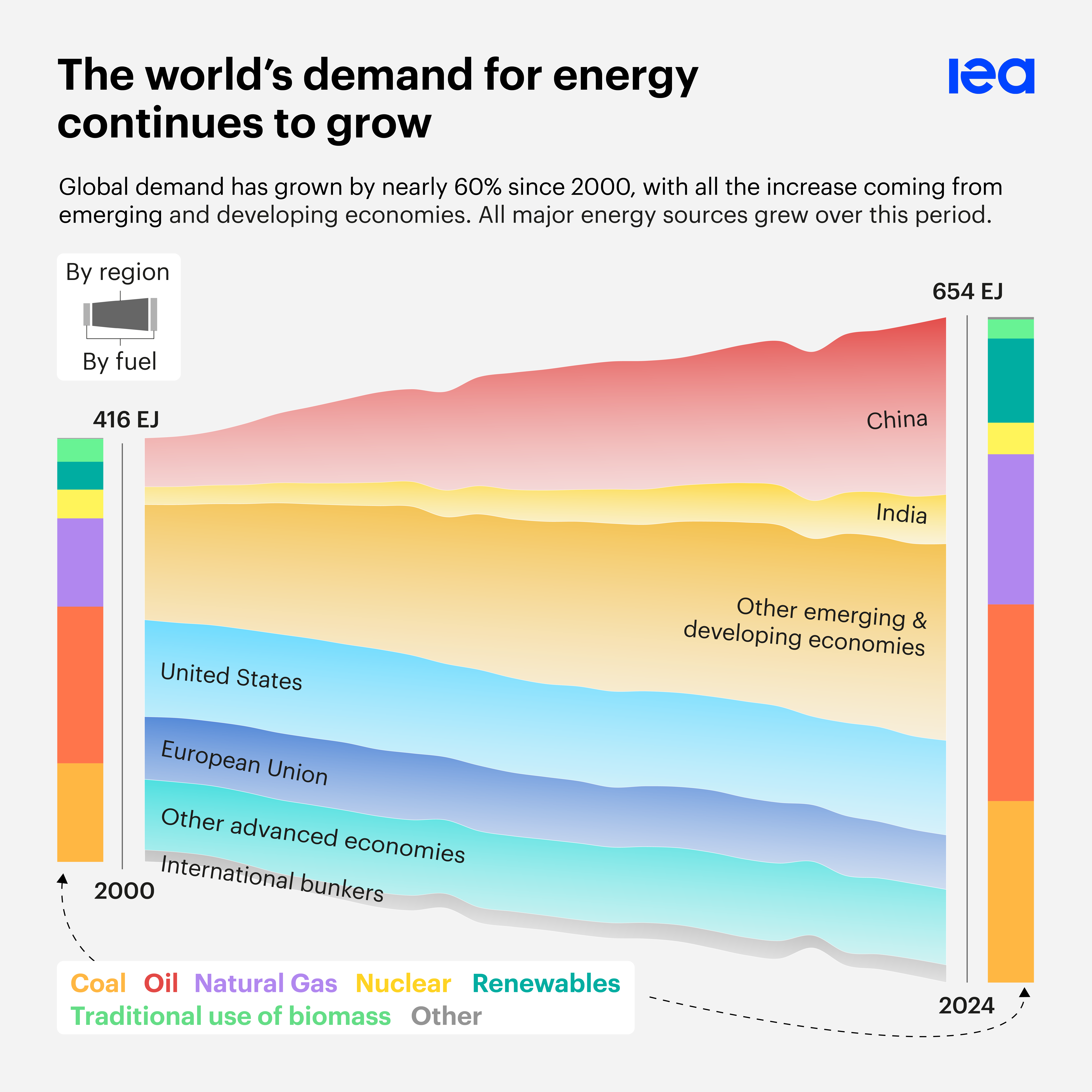
Global energy demand has risen by nearly 60% since 2000, with more than half of the increase taking place in China. All major energy sources grew over the period.
Now, looking ahead, energy market dynamics are set to be increasingly shaped by a group of emerging economies, led by India and Southeast Asia and joined by countries in the Middle East, Latin America and Africa. Collectively, they take up the baton from China – although no country alone comes close to replicating China’s impacts on energy markets. Learn more in our World Energy Outlook 2025 – and dig deeper in our recent podcast episode on the new geography of energy demand.
|
|
WHAT WE'RE READING & WATCHING:
|
Mid-2026: 2nd IEA Summit on Clean Cooking in Africa
|
|
|
|
|