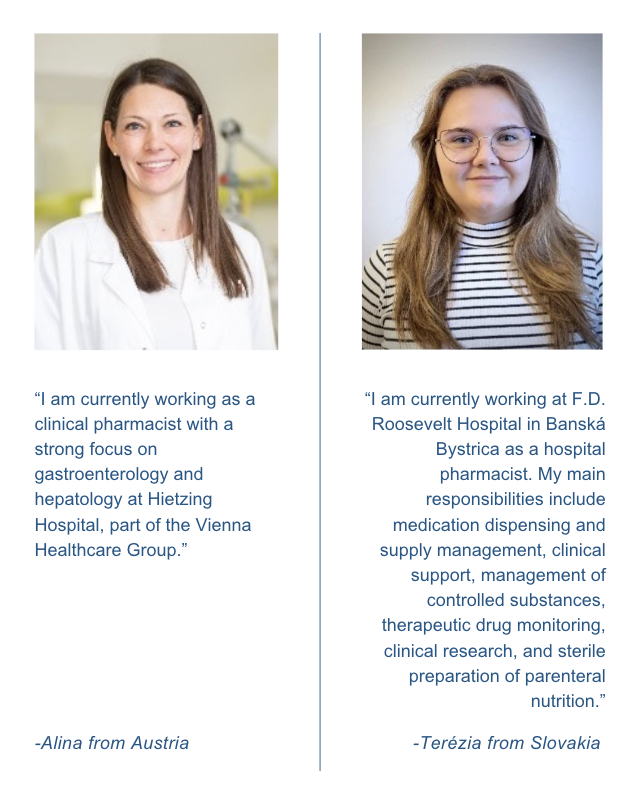
- How does one become a hospital pharmacist in your country?
A: In Austria, after completing a university pharmacy degree, it is mandatory to undergo a year of practical training, supplemented by courses from the Austrian Chamber of Pharmacists, before being qualified to work independently in community or hospital settings.
S: In Slovakia, to become a hospital pharmacist, you need to successfully complete a university degree in pharmacy and have the motivation to work in a hospital setting. No additional courses are required to start working as a hospital pharmacist.
- How is the university/training pathway organized?
A: The six-semester bachelor’s program is followed by a four-semester master’s program and the additional training year.
S: As mentioned, completing a pharmacy degree is the main requirement to become a hospital pharmacist in Slovakia. It is a five years master´s program. There is also a specialization program in hospital pharmacy, which can be undertaken after graduation. This program typically lasts at least three years, but it is not mandatory for employment as a hospital pharmacist.
- Do you attend lectures during your residency, and are you paid?
A: However, the Austrian Chamber of Pharmacists offers an optional educational pathway to become a certified hospital pharmacist. Although this program is not mandatory, completing it leads to a considerable increase in salary.
S: I’m currently not a resident, but a fully employed pharmacist at the hospital. Since it’s essential that we pharmacists remain committed to lifelong learning I do attend different seminars and workshops and I am open to try an internship at other hospital pharmacies.
- What inspired you to choose this path and what challenges have you faced along the way?
A: Before moving into the hospital setting, I spent five years in community pharmacies, which I eventually found insufficiently challenging. Seeking deeper specialization, becoming a clinical pharmacist was the only option in Austria.
S: I was inspired to become a hospital pharmacist because the role perfectly combines my passion for medical science with my commitment to patient care. Working in a hospital allows me to collaborate with other healthcare professionals, ensure the safe and effective use of medicines, and continuously develop my clinical knowledge to improve patient outcomes.
Everyday we need to prove our worth in the clinical team, but every time we do so a patient benefits from it. I cannot stress the importance of lifelong education in this case enough.
- If you could change or improve one thing, what would it be?
A: In Austria, we are still far from having enough positions for clinical and hospital pharmacists. However, this is an issue that needs to be addressed by policymakers.
S: I wish more young professionals in our field would take the leap and join hospital pharmacies. We need the young and innovative brains to work on overcoming the limitations which we are often met with in hospital settings.
Want to share your story? Contact us for future features!
|