|
Newsletter of the International Energy Agency
Click here to view in your browser
|
Welcome back to the Energy Mix. In today's edition: The latest on the energy crisis stemming from the Middle East conflict and our emergency oil stock release; 10 options to ease price pressures on consumers; assessing the impacts on oil markets; a new podcast episode putting the stock release in context; Romania’s formal request to join the IEA; and more.
|
|
The IEA’s unprecedented response to historic disruptions in oil markets
|
The IEA is responding to the widespread energy market impacts of the conflict in the Middle East. The disruptions to oil and gas flows and to energy infrastructure in the region have major implications for energy security and affordability – and for the world economy.
The war in the region that began on 28 February has shrunk energy trade flows through the Strait of Hormuz to a trickle, creating what our Executive Director Fatih Birol has described as “the greatest threat to global energy security in history”, with a larger loss of oil supply than in the oil crises of the 1970s and a larger loss of natural gas supply than during the 2022 energy crisis linked to Russia’s invasion of Ukraine.
In response, IEA Member countries unanimously agreed on 11 March to release around 400 million barrels of additional oil supply to the market, by far the largest ever release of emergency oil stocks, to help address the unprecedented market disruptions. More details about countries’ contributions to the collective action are available here.
As part of the IEA’s international energy diplomacy efforts, our Executive Director is in close contact about the situation with governments around the world, including major energy producers and consumers. He was also invited by France, which holds the G7 Presidency, to take part in recent meetings of G7 Finance Ministers and of Energy Ministers about the impacts of the Middle East conflict. For more on Dr Birol’s high-level engagements amid the unfolding energy crisis, take a look at his posts on X and LinkedIn.
For more information, we have a dedicated web page on the situation in the Middle East and the implications for global energy markets, which we are updating regularly. It includes our new interactive tool, the Martine Chokepoints Shipping Monitor, which shows how flows for oil, gas and other cargoes have evolved since the war started. You can also watch our Executive Director’s recent remarks providing an overview of the situation in energy markets and the IEA’s response.
|
|
10 measures that can ease price pressures on consumers
|
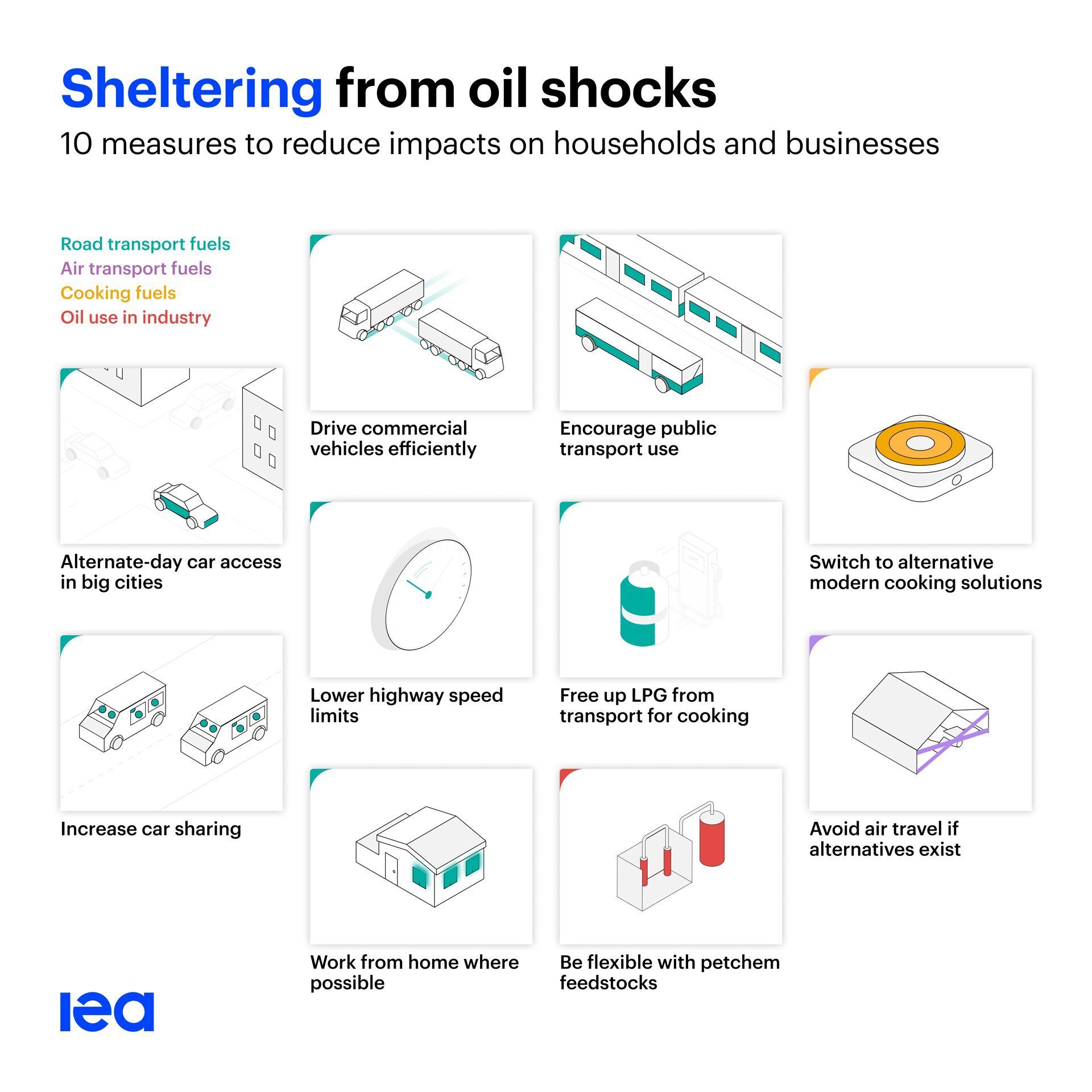
While the release of emergency oil stocks helps ease some of the pressure on the supply side, our new report highlights a range of actions on the demand side that governments, businesses and households can take to alleviate the impacts on energy affordability.
With crude oil prices above $100 per barrel and even sharper increases in the prices of refined products such as diesel, jet fuel and liquefied petroleum gas, the report identifies 10 measures that can be implemented quickly to ease strains on affordability.
The report “provides a menu of immediate and concrete measures that can be taken on the demand side by governments, businesses and households to shelter consumers from the impacts of this crisis,” Dr Birol said. “It draws on the IEA’s decades of expertise in this field and highlights measures that have been proven to work in practice in different contexts.”
The options focus primarily on road transport, which accounts for around 45% of global oil demand, but also cover aviation, cooking and industry. They include working from home where possible, lowering highway speed limits, encouraging a shift from private cars to public transport, and avoiding air travel where alternative options exist. Widespread adoption, where feasible, would amplify the global effects and help cushion the price shocks.
|
|
Oil markets face unprecedented supply disruptions
|
With traffic through the Strait of Hormuz largely halted, limited capacity to bypass the Strait, and storage filling up, Gulf countries have cut total oil production by over 10 million barrels per day, the report estimates. In the absence of a rapid resumption of shipping flows, supply losses are set to increase. Diesel and jet fuel markets look to be particularly vulnerable to an extended loss of Middle East production and exports, given limited flexibility elsewhere to increase output.
The emergency stock release by IEA countries provides a significant and welcome buffer, the report notes, but in the absence of a swift resolution to the conflict, it remains a stop-gap measure. According to the report, the ultimate impact on oil and gas markets and the broader economy from the conflict will depend not only on the intensity of military attacks and any damage to energy assets, but also, crucially, on the duration of disruptions to shipping through the Strait of Hormuz.
|
|
New podcast episode unpacks IEA's emergency stock release
|
The latest episode of our Everything Energy podcast dives into the release by IEA countries of 400 million barrels of oil from their emergency reserves to help stem disruptions in oil markets from the war in the Middle East.
Now available on Apple Podcasts and Spotify, the episode features IEA Director of Energy Markets and Security Keisuke Sadamori, who walks through the decision, explaining how it was made and what is happening now. He also puts it into historical context and highlights why this crisis has amounted to the biggest shock to global oil markets in history. Listen to it here.
|
To keep up with our very latest news and analysis, follow the IEA on social media ( LinkedIn, X) as well as our Executive Director Fatih Birol ( LinkedIn, X) |
|
Romania makes formal request to join IEA as Member country
|
The government of Romania has formally requested to become a member of the IEA, marking a significant step in the country’s deepening cooperation with the Agency and its participation in global energy governance. The formal request follows Dr Birol’s visit to Bucharest in November 2025, during which he met with Romania’s President Dan Nicușor, Prime Minister Ilie Gavril Bolojan Dan and Minister of Energy Bogdan-Gruia Ivan.
Romania’s request will be considered by IEA Member governments at the next meeting of the IEA Governing Board. If approved, Romania would begin the process toward membership, which involves aligning national energy policies, data and emergency preparedness frameworks with IEA standards and requirements.
|
Our Executive Director recently hosted African Development Bank Group President Sidi Ould Tah at our headquarters in Paris. They discussed key African energy priorities, including clean cooking and ensuring African countries benefit from their mineral resources.
Our new commentary focuses on energy service companies – firms that develop and implement energy efficiency projects, typically financed through verified energy savings. It finds these companies are playing a growing role in delivering energy efficiency improvements across buildings, industry and transport infrastructure – although this growth remains highly geographically concentrated in just two countries. Read the commentary.
A new report looks at how Kenya, a regional leader in energy development, can strengthen its electricity system amid rising shares of variable renewable energy. Read the report.
Another new report assesses the opportunities for efficient grid-interactive buildings to support India’s energy goals. It finds that this approach offers an important solution for optimising electricity use, reducing peak demand and enhancing system flexibility. Learn more.
We also recently analysed the financial tools needed to support the development of the ASEAN Power Grid, a longstanding regional initiative which aims to interconnect national power systems to meet Southeast Asia’s fast-growing electricity demand, strengthen energy security and support the region’s energy transition. Read the report.
|
With a major energy crisis unfolding, the IEA is supporting market stability with an emergency stock release of historic proportions. But the demand side of the equation also has a part to play. Our new report sets out immediate options that can help shelter consumers from today's oil shock. Learn more. |
|
WHAT WE'RE READING, WATCHING & LISTENING TO:
|
Early April: The State of Energy Policy 2026
14 April: Oil Market Report
April: 10 Questions on Energy and AI
|
|
|
|
|