|
Newsletter of the International Energy Agency
Click here to view in your browser
|
Welcome back to the Energy Mix. In today's edition: Our Executive Director meets with the German Chancellor in Berlin; how governments can best support consumers during the energy crisis; the Middle East crisis is changing the outlook for natural gas; data and analysis on key global energy trends in 2025; a new podcast episode on critical mineral supply chain risks; and more.
|
|
Executive Director meets Chancellor of Germany to discuss energy impacts of Middle East crisis
|
As the lack of shipping flows through the Strait of Hormuz continues to disrupt global oil and gas supplies, our Executive Director Fatih Birol recently travelled to Berlin where he met with Chancellor Friedrich Merz of Germany and other senior government leaders to discuss the implications of the unfolding crisis for energy markets, supply chains and industrial competitiveness.
Chancellor Merz and Dr Birol discussed the conflict in the Middle East and the effects it is having on energy supplies and economic activity in Europe and around the world. They also spoke about the IEA’s work to support governments in responding to the supply disruptions, as well as policy options to shelter consumers from higher prices, strengthen energy security and support energy-intensive industries.
During his visit, Dr Birol also had a bilateral meeting with Germany's Minister of Economic Affairs and Energy Katherina Reiche to discuss the latest developments in oil and gas markets, including the availability of refined products in Europe and internationally. And he met with Germany’s Environment, Nature Conservation and Nuclear Safety Minister Carsten Schneider on the impacts of the Middle East conflict and the outlook for different fuels and technologies.
While in Berlin, our Executive Director addressed the high-level segment of the Petersberg Climate Dialogue, which was led by Chancellor Merz. Dr Birol’s remarks focused on the current energy crisis, how today's policy responses could shape the longer-term outlook and why industrial competitiveness remains central in this context.
|
|
How governments can best support consumers during this energy crisis
|
As the effects of the Middle East conflict have driven up prices for key fuels – including jet fuel, diesel and gasoline – many governments have announced emergency measures to protect consumers from higher costs.
We recently published a new commentary explaining how governments can respond most effectively to support consumers. The commentary notes that broad-based price support measures – such as fuel price caps or tax cuts – primarily benefit higher-income households while putting pressure on public finances.
A more effective approach is to target support at households most vulnerable to price shocks, ensuring that public money is used efficiently and reaches those most in need. At the same time, well-designed public information campaigns can help consumers reduce their demand in ways that lower their exposure to high energy prices.
To learn more – including where international experience can offer useful lessons – read the analysis. And on Wednesday, IEA experts will host a webinar presenting key findings from the Energy Crisis Policy Response Tracker, identifying emerging trends in the types of policies that are being introduced, how they are being designed, and key regional differences. Register for the webinar here. |
|
Middle East crisis disrupts gas markets and delays new LNG supply
|
The war in the Middle East has brought disruption to international gas markets, with our latest quarterly Gas Market Report showing how the major supply shock is fuelling volatility and pushing back an expected wave of new LNG supply.
The de facto closure of the Strait of Hormuz since the start of March has brought shipping traffic to a near standstill, taking nearly 20% of global LNG supply off the market and sending prices sharply higher across key importing regions. During a period of intense volatility in March, gas prices in Asia and Europe climbed to their highest levels since January 2023, weakening demand in major LNG importing markets.
The crisis has also brought a sudden halt to a period of market rebalancing seen during the 2025-26 heating season – when strong LNG supply growth had helped ease prices. Conditions shifted abruptly in March as the conflict led to the effective closure of the strait. Global LNG production fell by 8% year-on-year that month, with a sharp drop in exports from Qatar and the United Arab Emirates only partly offset by higher output elsewhere.
Beyond the immediate disruption, the report warns that damage to LNG liquefaction infrastructure in Qatar is set to delay the anticipated global wave of new LNG supply by at least two years. The combined effect of short-term supply losses and slower capacity growth could result in a cumulative loss of around 120 billion cubic metres of LNG supply between 2026 and 2030 – extending tight market conditions through 2026 and 2027.
|
|
Global energy demand growth was met by a diverse range of sources in 2025
|
Worldwide energy demand grew at a slower pace in 2025 than in the previous year, but electricity consumption continued to rise much faster than overall demand – with solar PV becoming the largest contributor to growth in global energy supply for the first time, according to the latest edition of our Global Energy Review.
The report provides a comprehensive global assessment of trends across the energy sector in 2025. Based on the latest data, it covers energy demand, electricity generation and use, energy technology deployment and energy-related carbon dioxide emissions.
Global energy demand growth slowed to 1.3% in 2025, slightly below the previous decade’s average of 1.4% and significantly lower than in 2024 amid lower global economic growth, less extreme temperatures in some regions and the rapid uptake of more efficient technologies. At the same time, global electricity demand increased by around 3% – slower than in 2024, but still above the average of the past decade.
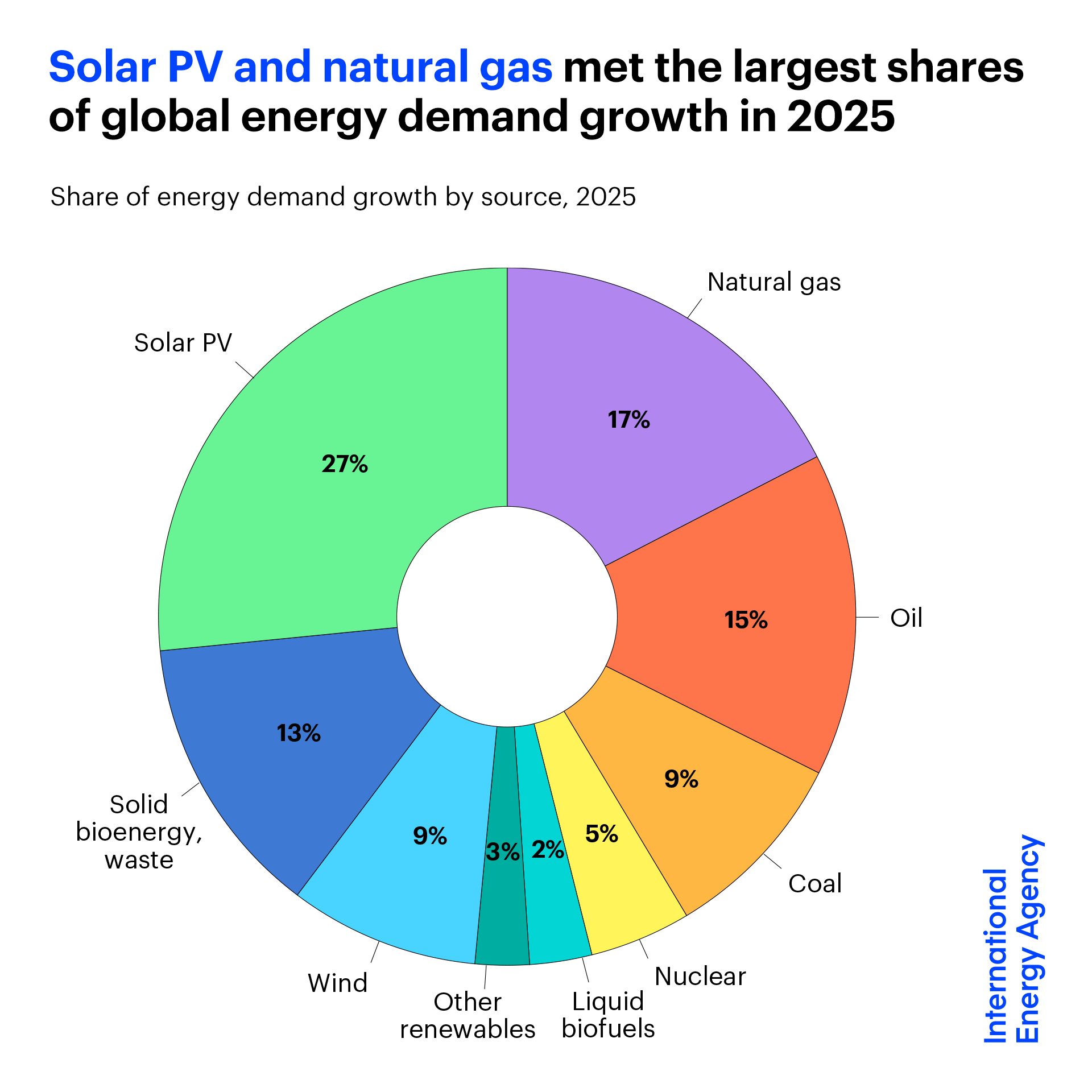
All major fuels and technologies expanded in 2025 to meet rising demand, although at very different rates. Solar PV was the single largest contributor to growth in global energy supply, accounting for more than 25% of the increase – the first time on record that a modern renewable source has led growth in global primary energy supply. Natural gas took the next largest share, at 17%, reflecting its critical role in power generation in many countries.
|
To keep up with our very latest news and analysis, follow the IEA on social media ( LinkedIn, X) as well as our Executive Director Fatih Birol ( LinkedIn, X) |
|
IEA hosts high-level energy dialogue with Türkiye and Australia
|
|
The Presidency of COP31 has named the IEA as a strategic partner of the international climate conference that will take place in Antalya, Türkiye, in November. The partnership was announced by COP31 President-Designate Murat Kurum and Dr Birol at the opening of a jointly hosted High-Level Energy Transition Dialogue at our headquarters in Paris.
The High-Level Dialogue convened ministers, ambassadors and other senior officials of governments representing almost two-thirds of the world’s population, as well as a broad range of high-level stakeholders, including leaders from four previous COP Presidencies, private sector executives and civil society figures. It was held in partnership with Australia, which is leading the negotiations for COP31 in close cooperation with Pacific countries – with Fiji and Tuvalu hosting pre-COP events in October.
|
|
New podcast episode focuses on the risks in critical mineral supply chains
|
Now available on Apple Podcasts and Spotify, the latest episode of our Everything Energy podcast examines the rising strategic importance of key energy-related minerals, including copper, lithium, nickel, cobalt, graphite, rare earth elements and more.
The episode features conversations with Benjamin Gallezot, the critical minerals envoy from France – which holds this year’s G7 Presidency – and Jakob Stausholm, the former CEO of multinational mining group Rio Tinto. Speaking on the sidelines of the IEA’s Ministerial Meeting in February, they discuss why policymakers and industry alike are focusing on critical minerals, and what can be done to strengthen security of supply. Tae-Yoon Kim, the head of the IEA’s Critical Minerals Division, also joins the episode to share the latest data and analysis on the subject, as well as how the IEA is bringing countries together to tackle supply risks.
The Everything Energy podcast offers perspectives on a wide range of leading global energy issues. In recent episodes, IEA experts have explored several dimensions of the current energy crisis stemming from the war in the Middle East, including 10 measures that could help shelter consumers from the effects of higher oil prices, how the crisis is rippling across Southeast Asia and the growing disruptions to oil markets.
|
Our Executive Director recently had a bilateral meeting with Nigeria’s Minister of State for Petroleum Resources Ekperikpe Ekpo. During a discussion on the current energy crisis, Dr Birol thanked him for Nigeria's exports of jet fuel at a challenging time for markets, as well as Nigeria's efforts to deliver additional supplies. They also agreed to take a new step forward to deepen the IEA-Nigeria institutional relationship.
Dr Birol had a call last week with the United Arab Emirates’ Minister of Industry and Advanced Technology Sultan Al Jaber, who is also the CEO of Abu Dhabi National Oil Company (ADNOC). They discussed the longstanding cooperation between the UAE and the IEA, as well as the UAE’s strong support for the COP process following its Presidency of COP28.
On the occasion of the recent meeting of G7 Environment Ministers in Paris, our Executive Director met with Canada's Minister of Environment, Climate Change and Nature Julie Dabrusin to discuss priorities such as energy security, energy efficiency and affordability.
The number of lithium-ion and similar batteries reaching end-of-life is expected to rise sharply from the mid-2030s onwards, making managing battery waste safely and efficiently a key challenge. Our new joint study with the European Patent Office looks at innovation trends in battery recycling. Read the report and the accompanying news article.
|
All major fuels and technologies expanded to meet rising energy demand in 2025, but solar PV was the single largest contributor, followed by natural gas. Overall, renewable sources and nuclear met nearly 60% of all growth in energy demand – and power generation from these sources exceeded total growth in electricity demand. Learn more in our Global Energy Review 2026. |
|
WHAT WE'RE READING & WATCHING:
|
8 May: Energy Policy Review of Portugal
11 May: Energy Policy Review of Austria
20 May: Global EV Outlook 2026
Late May: World Energy Investment 2026
|
|
|
|
|