|
Newsletter of the International Energy Agency
Click here to view in your browser
|
Welcome back to the Energy Mix. In today's edition: How the current energy crisis is reshaping global energy investment; meeting with the Prime Minister of Thailand and other leaders on the response to the crisis; our latest outlook for electric vehicles; the battery storage boom in power systems; a new podcast episode on hydropower; and more.
|
|
Middle East crisis is set to reconfigure energy investment flows, with security in focus
|
Amid the conflict in the Middle East, countries and companies are rethinking their energy investment strategies in response to heightened concerns over energy security and the reliability of global trade flows.
The latest edition of our flagship World Energy Investment report highlights how the current energy crisis is changing risk perceptions and bolstering moves towards greater diversification. Coming just a few years after the energy crisis centred around Russia’s invasion of Ukraine in 2022, today’s supply shock is expected to leave a lasting imprint on future investment priorities – particularly in Asia and the Middle East, where the impacts of the disruptions to shipping flows through the Strait of Hormuz have been felt most acutely.
The report projects that global energy investment will reach $3.4 trillion in 2026, a slight increase year-on-year. Around $2.2 trillion is expected to go towards grids, storage, low-emissions fuels, nuclear, renewables, efficiency and electrification in 2026, while around $1.2 trillion is set to be invested in oil, natural gas and coal.
Despite higher oil prices, oil investment is expected to decline for a third consecutive year in 2026. The report finds that uncertainty over the duration of the price spike, long project lead times, supply chain constraints and tighter offshore rig markets are limiting near-term spending responses outside the Middle East. At the same time, natural gas investment is projected to rise to the highest level in a decade, supported by a wave of new LNG export projects.
The report finds growing interest among fuel-importing countries in energy sources available domestically, including renewables, nuclear power and, in some cases, coal. And while annual investment growth in renewables has moderated following several years of rapid expansion, renewables and nuclear power still account for more than 70% of total power generation investment globally.
To learn more, read the press release and explore the full report. You can also watch the launch event featuring our Chief Energy Economist Tim Gould and Executive Director Fatih Birol.
|
|
Engaging with global leaders to address the impacts of the unfolding energy crisis
|
We continue to engage closely with government leaders around the world as the energy crisis unfolds. Our Executive Director recently welcomed Prime Minister Anutin Charnvirakul of Thailand who visited our headquarters in Paris with a high-level delegation to discuss the implications of the crisis.
The discussion focused in particular on the challenges facing countries in Asia, the destination for the vast majority of oil and gas exports that pass through the Strait of Hormuz. Dr Birol and the Prime Minister also discussed how the IEA and Thailand could work together even more closely in the future, highlighting energy security and affordability as key areas of cooperation. Prime Minister Charnvirakul – who was accompanied by Deputy Prime Minister and Minister of Foreign Affairs Sihasak Phuangketkeow and Deputy Prime Minister and Minister of Finance Ekniti Nitithanprapas – invited Dr Birol to visit Bangkok to meet with him and his full cabinet to discuss energy strategy.
Our Executive Director recently addressed a meeting of G7 finance ministers and central bank governors in Paris at the invitation of Finance Minister Roland Lescure of France, which holds this year's G7 Presidency. In his remarks, Dr Birol highlighted the risks to the world economy from the current disruptions to supplies of oil, gas, fertilisers and other key commodities, as well as the growing risks posed by the rapid depletion of oil inventories globally. Last week, Dr Birol also took part in a meeting of our high-level coordination group with the heads of the International Monetary Fund, the World Bank Group and the World Trade Organization to maximize our institutions’ response to the energy, trade and economic impacts of the war in the Middle East.
Brazil's Minister of Finance Dario Durigan met with Dr Birol in Paris to discuss the crisis and Brazil's role as a major and reliable energy supplier to international markets. And Dr Birol recently travelled to London, where he met with top government officials to discuss energy markets and policy responses to the crisis. He also spoke about current energy security risks during a livestreamed discussion hosted at Chatham House.
We also published a significant update to our Energy Crisis Policy Response Tracker, which now includes data on structural policies aimed at enhancing long-term energy resilience, in addition to existing data on measures to conserve energy and protect consumers.
|
|
Close to 30% of cars sold this year are set to be electric
|
After strong growth last year, global electric car sales are expected to rise again in 2026, reaching 23 million and accounting for close to 30% of all cars sold worldwide, according to the new edition of our annual Global EV Outlook.
The report examines key market and policy trends related to the deployment of electric vehicles and charging infrastructure, as well as the implications of growing EV adoption for electricity, oil and emissions. Amid the major energy crisis stemming from the war in the Middle East, the new outlook also presents initial data for the early months of 2026 and considers the consequences of the current energy crisis for EV policy and market development.
In 2025, global electric car sales grew by 20% to exceed 20 million, meaning that a quarter of all new cars sold worldwide were electric. Although global sales of electric cars fell by 8% in the first quarter of 2026 compared with the same period a year earlier, following policy changes in China and the United States, the overall decline masked strong sales growth in many other markets where EVs are becoming increasingly cost-competitive.
This trend could reinforce demand, including from consumers worried about volatile fuel prices. By 2035, even without any new policy announcements, the global fleet of EVs (excluding two- and three-wheelers) is projected to surge as high as 510 million, up from nearly 80 million today.
|
|
Battery storage is scaling up and taking on a larger role in power systems
|
As the result of falling costs and greater flexibility needs, battery storage is playing a growing role in power systems worldwide – acting as a key tool that can provide a range of critical system services at once.
According to our new commentary, battery deployment expanded strongly in 2025 and broadened across markets – with rapid growth in countries such as Australia and Saudi Arabia, where storage is increasingly being used to support the integration of rising shares of variable renewables. And in regions that have been at the forefront of renewable integration and battery deployment, batteries now play an essential role in continuously balancing electricity demand and supply.
Comparatively short construction and development timelines are further supporting the rapid deployment of utility-scale batteries, in particular. In many markets, projects typically take around two years to develop and commission, giving them an important advantage in systems that seek flexible capacity quickly.
|
To keep up with our very latest news and analysis, follow the IEA on social media ( LinkedIn, X) as well as our Executive Director Fatih Birol ( LinkedIn, X) |
|
Examining hydropower's major – but often overlooked – contributions to the electricity sector
|
Hydropower is the third largest source of power generation globally, producing roughly as much electricity as solar and wind combined. Yet despite its huge role in electricity systems around the world, it is often left out of conversations on energy.
In the latest episode of the IEA’s Everything Energy podcast, renewable energy analyst Yasmina Abdelilah explains how the role of hydropower in electricity systems has evolved in recent decades. With electricity demand surging across the globe, she highlights the benefits hydropower could deliver across both advanced and emerging economies – and what is needed to overcome key barriers. You can listen to the episode on Apple Podcasts and Spotify.
|
Our Executive Director recently met with India’s Deputy National Security Adviser, Ambassador Pavan Kapoor, at our headquarters in Paris. Discussions focused on secure and diversified critical mineral supply chains for India's rapidly growing economy, as well as how the IEA can support the country's energy security priorities.
We convened senior executives from around the world on Friday to discuss the economic and supply chain implications of the current energy crisis. Some 80 business leaders took part in the meeting of the IEA Energy Business Council, representing companies from across the energy sector – including oil, gas, renewables, nuclear, bioenergy, critical minerals and more. The meeting was chaired by our Executive Director and provided an opportunity to discuss how the crisis is affecting the private sector.
Our Deputy Executive Director Mary Burce Warlick spoke at a conference convened by Germany's Foreign Office on enhancing energy security in Europe, drawing on key lessons from Ukraine. She highlighted the central role that international cooperation plays in boosting energy system resilience, as well as the IEA's strong support for Ukraine’s energy security.
The Heat Pump Taxonomy Project, led by the IEA in collaboration with stakeholders from over 50 institutions, has developed a common framework for classifying heat pumps – a key step to support cross-country comparability and global policymaking. Explore the taxonomy through our new interactive tool.
|
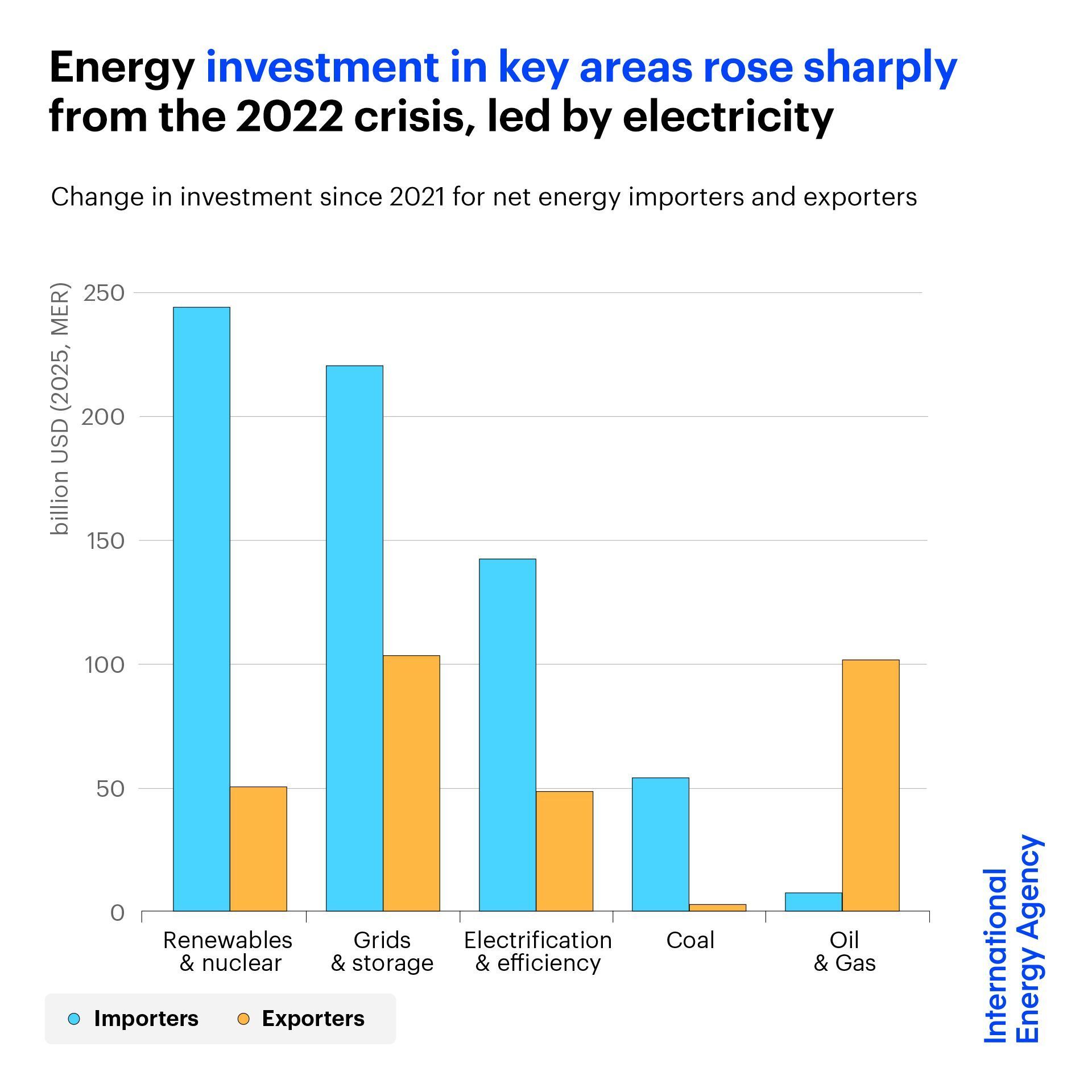
Following the energy crisis triggered by Russia's invasion of Ukraine in 2022, investment in key areas of the energy sector rose sharply, according to our World Energy Investment 2026 report. Coming just a few years later, the current energy shock from the war in the Middle East is also set to leave a lasting imprint on future energy investment priorities. Learn more. |
|
WHAT WE'RE READING & WATCHING:
|
Mid June: Southeast Asia Energy Outlook 2026
|
|
|
|
|