|
Newsletter of the International Energy Agency
Click here to view in your browser
|
Welcome back to the Energy Mix. In today's edition: What the energy crisis could mean for electrification around the world; discussion market developments with the Prime Minister of the Netherlands and other leaders; managing rising cooling demand in India; how international exchanges help energy innovation; a new podcast episode on energy investment; and more.
|
|
What the energy crisis could mean for electrification
|
The disruption to energy supplies through the Strait of Hormuz amid the conflict in the Middle East is leading countries to look increasingly at the options for meeting more of their energy needs at home. This could provide further momentum for electrification, which had already been accelerating around the world.
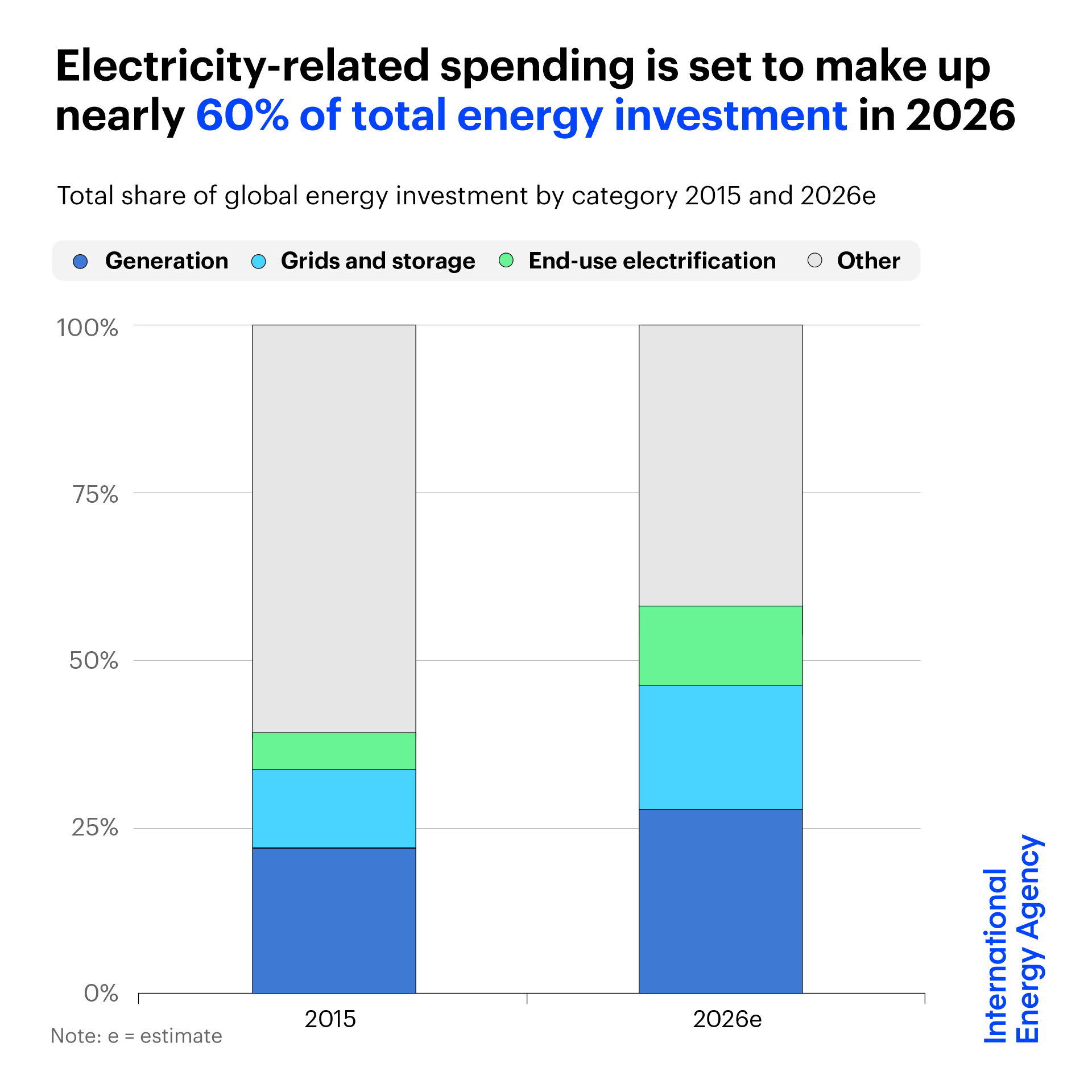
Electrification – through heat pumps, electric vehicles and electrified industrial processes – is expanding rapidly, with investment growing around 15% year-on-year, according to our recent World Energy Investment report. Electrification is also one of the key trends contributing to the strong growth in global demand for electricity, which increased more than twice as fast as overall energy demand last year.
Investments in renewables, nuclear, electrification and energy efficiency in the past decade have improved energy security in major fuel-importing regions, our investment report finds. At the same time, progress on electrification is uneven, accelerating when infrastructure, prices and finance align – and slowing when barriers persist due to issues such as affordability, grid readiness or technology risk.
The IEA continues to track these developments around the world. At a recent high-level event in Bonn, the COP31 Presidencies of Türkiye and Australia announced that they had officially commissioned the IEA to produce a special report this year on how to accelerate electrification in line with increasing electricity’s share of final energy consumption globally from around 20% today to 35% by 2035.
In the European Union, electrification is a central part of reaching goals on energy security, competitiveness, affordability and emissions reductions. Our first article in a new commentary series explores EU electrification trends and prospects, including how the current energy crisis is improving the competitiveness of electric technologies and which policies could unlock further progress.
Read the commentary, explore the findings of our World Energy Investment report and join us tomorrow for the livestreamed launch of our new Southeast Asia Energy Outlook 2026, which will look at electrification and other key trends in that region, which is one of the most heavily impacted by the current energy crisis.
|
|
The latest IEA information and analysis on the energy impacts of the crisis
|
The IEA is continuing to track closely the effects of the war in the Middle East on energy markets, as well as how consumers and producers are responding to the disruptions.
To learn more about the situation and the IEA response, including the largest ever release of emergency oil stocks by our Member countries, visit our dedicated topic page. Our website also has an interactive data tool examining countries’ reliance on oil and gas supplies from the Middle East and another on key shipping chokepoints in the region. We continue to update our Energy Crisis Policy Response Tracker on government actions to conserve energy and support consumers in response to the effects of the crisis.
The next edition of our monthly Oil Market Report will be released on Wednesday, providing the latest data and analysis on oil supply, demand and trade. And a special commentary on supply side responses to the crisis will be published later this week.
|
|
Discussing the latest developments with the Prime Minister of the Netherlands and other leaders
|
Our Executive Director Fatih Birol met last week with Prime Minister Rob Jetten of the Netherlands to discuss the impacts and implications of the energy crisis resulting from the war in the Middle East and ways to bolster energy security in the near and longer term.
In their bilateral meeting in The Hague, Prime Minister Jetten and Dr Birol spoke about the current geopolitical and energy market situation, as well as the importance of oil and natural gas stocks in buffering against market shocks. Dr Birol also met with the Netherlands' Minister of Climate & Green Growth Stientje van Veldhoven. They discussed the latest energy market developments amid the Hormuz crisis and how expanding electrification in Europe can support energy security and affordability – as well as key areas of the IEA’s work.
Earlier in the week, Dr Birol travelled to Luxembourg where he had a bilateral meeting with HRH Grand Duke Guillaume at the Grand Ducal Palace that covered key global energy trends and the importance of international cooperation for energy security. In Luxembourg City, he also met with Minister of Energy Lex Delles to speak about the energy security implications of the crisis and key findings from the IEA's new review of Luxembourg's energy policies. And he visited European Investment Bank President Nadia Calviño at the bank’s headquarters in Luxembourg to discuss how the latest energy market developments are affecting investment priorities.
Dr Birol also spoke about the economic impacts of the market disruptions and Europe's response with Greek Minister of Economy and Finance Kyriakos Pierrakakis, who also serves as the President of the Eurogroup, when he visited our headquarters earlier this month.
We are also strengthening ties with countries around the world as they respond the crisis. Dr Birol recently welcomed Nigeria's Ambassador to France Ayodele Oke to our headquarters to discuss Nigeria's request to join the IEA Family. They spoke about the potential to extend cooperation in a range of areas and Nigeria's important contributions to energy security amid the current crisis.
|
|
The challenges of managing rising demand for air conditioning in India, particularly at night
|
Power consumption in India is on the rise as its economy and population grow – and as the use of air conditioning expands.
Since 2019, the country’s electricity demand has increased by 5% per year, driven in part by the growing use of air conditioning. Electricity supply has so far kept pace, with solar PV accounting for two-thirds of power capacity additions. However, ensuring adequate power generation capacity during periods of peak demand is emerging as a key electricity security challenge – particularly at night, when cooling demand grows but solar output falls.
This challenge has been highlighted in recent weeks as India has sweltered under an extreme heatwave. To learn more – and to understand the broader implications for India's energy security – read our new commentary.
|
To keep up with our very latest news and analysis, follow the IEA on social media ( LinkedIn, X) as well as our Executive Director Fatih Birol ( LinkedIn, X) |
|
How global exchanges help energy innovation
|
An understanding of the role that innovation can play in reducing the likelihood and severity of energy shocks led to the establishment of the IEA’s Technology Collaboration Programme, founded shortly after the Agency’s launch in 1974.
Over the past five decades, some 80 Technology Collaboration Programmes, or TCPs, have been created. Today, 38 active TCPs cover nearly every aspect of the energy ecosystem – from renewables and smart grids to hydrogen, carbon capture, fossil energy and next-generation fuels.
Last week, representatives from across the TCP network met at our headquarters in Paris for the sixth Universal TCP Meeting. They discussed priorities for strengthening international collaboration on innovation and the role new technologies can play in supporting governments’ ambitions to achieve a secure, sustainable and affordable energy future.
To learn more about what TCPs do, and the role global cooperation can play in supporting energy technology innovation, read our recent commentary.
|
|
Exploring the impacts of the energy crisis on investment trends
|
The latest episode of our Everything Energy podcast looks at how the current international energy crisis – the second in five years – is reshaping and reinforcing key energy investment trends around the world.
As energy security concerns intensify – and with many countries increasingly looking to meet demand with domestic energy sources – IEA experts Cecilia Tam and Kirsten Smith discuss the implications across different sectors, including oil, gas, coal, nuclear, renewables and electricity. They also speak about how investment in energy efficiency is evolving and how the crisis could affect the cost of capital for energy projects. You can listen to the episode on Apple Podcasts and Spotify.
|
The pace of deploying new energy technologies this decade will increasingly depend on whether governments, companies and international institutions can work together to overcome barriers to investment and infrastructure development, according to the latest Breakthrough Agenda report. Read it here.
Our latest Energy Policy Review assesses Luxembourg’s key energy sector challenges and provides recommendations on how to address them. It finds that the country is well positioned to strengthen energy security, reduce emissions and improve resilience thanks to its strong regional integration and highly digitalised energy system. But further targeted action in transport and buildings – supported by more integrated energy system planning – is needed to fully achieve its goals. Learn more.
Another new report looks at how renewables could play a larger role in district energy systems, helping to deliver more secure and efficient heating and cooling. District energy networks already supply heat to around 600 million people worldwide. Keep reading.
|
An estimated 60% of global energy investment is set to flow towards electricity-related projects in 2026 – a sign that momentum behind the Age of Electricity is growing. Learn more in our World Energy Investment 2026 report. |
|
WHAT WE'RE READING & WATCHING:
|
16 June: Southeast Asia Energy Outlook 2026
18 June: Global Hydrogen Review 2026
19 June: The supply side response to the energy crisis (commentary)
Early July: Q3 Gas Market Report
9 July: High-Level Session on Clean Cooking in Africa
|
|
|
|
|