|
Newsletter of the International Energy Agency
Click here to view in your browser
|
Welcome back to the Energy Mix. In today's edition: The latest developments in oil markets; the energy outlook for Southeast Asia; Ministers from around the world gather to discuss energy efficiency; G7 looks to IEA to help strengthen critical minerals security; decision makers around the world aim to accelerate electrification; vulnerabilities in global hydrogen supply chains; the global energy landscape on the eve of the crisis; and more.
|
|
Oil exports through the Strait of Hormuz rise – but significant risks remain
|
|
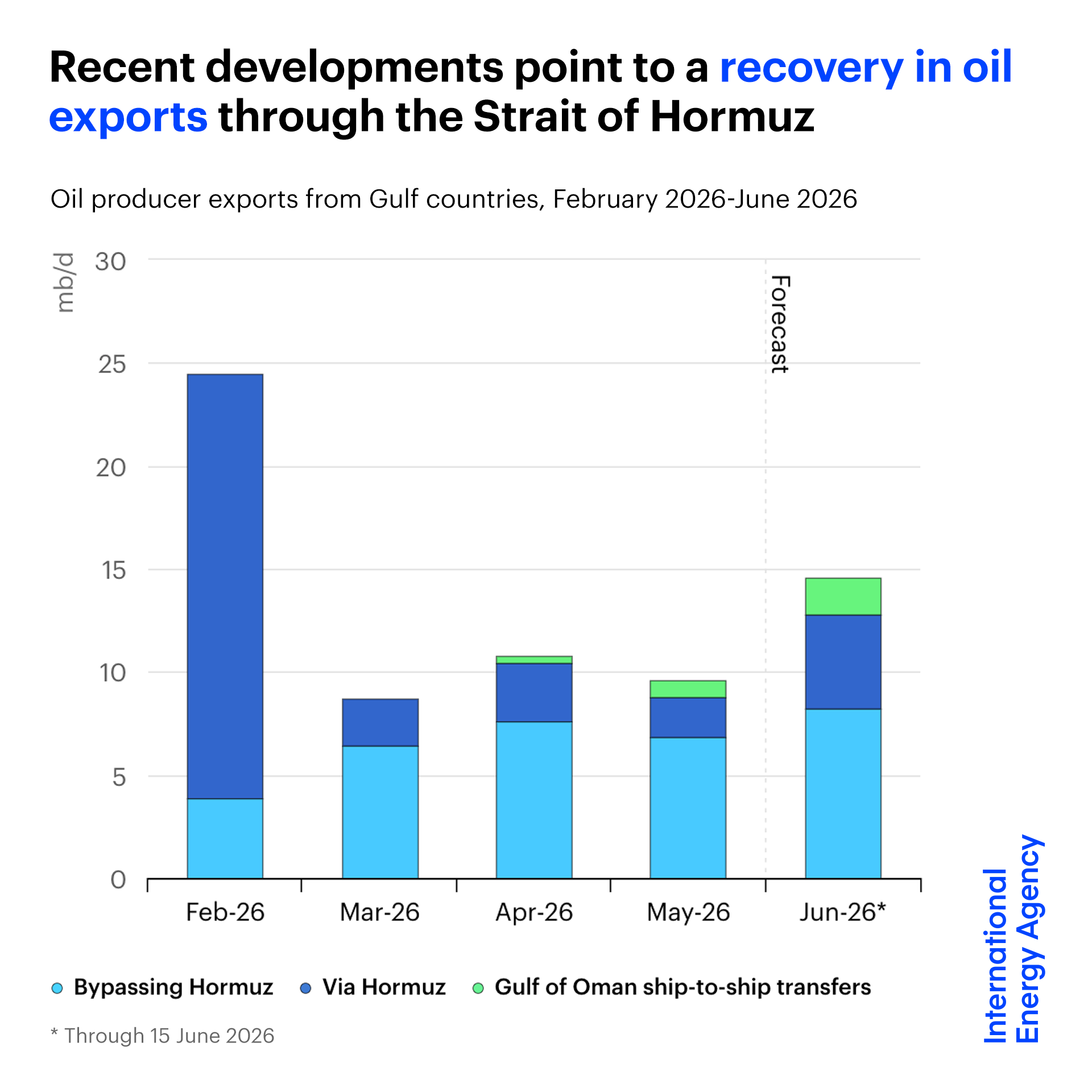
Oil prices have eased substantially in recent weeks on signs that fuel exports through the Strait of Hormuz have started to recover – underpinned by the interim agreement between the United States and Iran in mid-June seeking to reopen the Strait and to lay the foundations for a lasting peace.
A full recovery will nevertheless take time, according to our latest monthly Oil Market Report. Mines must be cleared from shipping lanes while tanker traffic and supply chains need to normalise. Still, the prospect of higher export flows provides some relief ahead of the peak summer demand season.
Oil demand has shifted considerably over the past four months in response to the crisis, with many consumers scaling back their energy use and governments taking steps to shelter households and businesses from the impacts, particularly in the Asia-Pacific region. Our latest forecast sees global oil demand falling by almost 5 million barrels per day in the second quarter of 2026 compared with the same period a year earlier.
There have also been three crucial adjustments on the supply side, as our new commentary highlights. First, a surge in oil prices incentivised market participants to draw down inventories at record rates, while the IEA’s largest-ever release of emergency stocks brought additional barrels to market. Second, there have been key responses from exporters, with some Gulf producers using alternative routes to market that bypassed the Strait, and a surge in crude exports from other suppliers, most notably the United States. Thirdly, the global refining system has made rapid adjustments to compensate not only for losses of Middle Eastern crude oil, but also for the collapse in exports of refined products from the region.
Another major factor in the readjusting was the steep drop in China’s crude oil imports, which plunged by 40% – or 4.6 million barrels per day – between February and May, helping significantly to ease wider pressures in the global market.
The oil market outlook nonetheless remains highly uncertain. The IEA will continue to closely monitor the situation, while remaining in close dialogue with oil exporters and importers around the world. Read the commentary on how oil supplies readjusted in response to the crisis – and the highlights and overview of the June edition of our Oil Market Report. |
|
Strait of Hormuz crisis reinforces need for Southeast Asia to tackle energy vulnerabilities and increase diversification
|
Disruptions to oil and gas flows through the Strait of Hormuz have drawn attention to structural risks in Southeast Asia’s energy sector, our new report finds – with stronger action needed to bolster energy security and affordability as the region’s energy use soars.
The 2026 edition of the Southeast Asia Energy Outlook provides a comprehensive assessment of the latest energy developments across the fast-growing region, as well as updated projections for the coming decades. As energy security concerns move ever higher on the policy agenda for countries in Southeast Asia and beyond, this year’s report explores the trajectory that the region was on prior to the current energy crisis – and considers the potential implications of the crisis for policy priorities and investment strategies.
So far, governments have focused on short-term measures to ease demand, such as encouraging residents to work from home. But the report finds it will be equally important to address deeper energy system vulnerabilities, including by diversifying energy sources. Based on today’s policy settings, Southeast Asia’s energy import bill set to rise to $400 billion by 2050, or 5% of its economy.
To learn more, read the press release and explore the full report. You can also watch the report launch with our Executive Director Fatih Birol, Chief Energy Economist Tim Gould and Sue-Ern Tan, the Head of the IEA Regional Cooperation Centre in Singapore.
|
|
Ministers to focus on energy efficiency as a key response to crisis at Global Conference
|
The current energy crisis has brought renewed attention to energy efficiency as an important way of strengthening energy security and affordability while also delivering emissions reductions.
Co-chaired by Canada’s Minister of Energy and Natural Resources Tim Hodgson, Minister of Environment and Climate Change Julie Dabrusin, and our Executive Director Fatih Birol, the Global Conference is bringing together over 600 participants, including Energy Ministers from dozens of countries around the world, CEOs from the energy sector and beyond, and leaders from international organisations and civil society.
They will take part in two days of high-level panels, roundtables and meetings, with a focus on accelerating progress on energy efficiency. Many of the events will be livestreamed – you can watch them here.
For more, read Dr Birol’s new opinion article for the Financial Post highlighting the opportunity Canada and countries around the world have to use energy more efficiently, making themselves more resilient to future shocks and more economically competitive.
|
|
G7 leaders aim to strengthen critical minerals security with IEA support
|
|
G7 leaders issued a declaration that included new commitments to secure critical mineral supply chains – including a request for the IEA to help establish a joint cooperation mechanism to guard against potential future supply disruptions and price instability.
Our support for the G7 and partners builds on our longstanding leadership on critical minerals security. Our annual Global Critical Minerals Outlook will be released next month with the latest data and projections on the supply of and demand for key energy minerals based on the latest policy and technology developments.
|
To keep up with our very latest news and analysis, follow the IEA on social media ( LinkedIn, X) as well as our Executive Director Fatih Birol ( LinkedIn, X) |
|
At IEA-WLGA event, governments and industry leaders discuss strengthening global LPG supply resilience to support clean cooking access
|
Government representatives, industry leaders and international organisations discussed last week how to strengthen the resilience of global liquefied petroleum gas (LPG) supplies in light of the disruptions caused by the Strait of Hormuz crisis. The discussions took place at the LPG Leadership Forum that we hosted together with the World Liquid Gas Association at our headquarters in Paris.
Opened with remarks from our Executive Director, the forum brought together delegates from around 20 governments and more than 80 senior industry representatives to examine the implications of the crisis for global LPG markets and identify practical measures to improve supply security.
Discussions focused on strategic LPG storage and reserve mechanisms, the protection of critical infrastructure, supply diversification and strengthening national energy resilience, particularly for developing economies and import-dependent markets in Africa. Participants recognised the vital role LPG plays in supporting energy security and particularly as the primary cooking fuel for 3.4 billion people across the developing world.
Read our news article for more and listen to the recent episode of our Everything Energy podcast that takes a closer look at the impacts of the energy crisis on LPG supplies. It unpacks what the resulting price increases and supply shortages have meant for some of the world’s most vulnerable communities – and the impact of recent market turbulence on expanding clean cooking access, particularly in sub-Saharan Africa.
|
|
At COP31-IEA High-Level Dialogue, decision makers from across globe emphasise goals of accelerating electrification and expanding clean cooking access
|
Together with the COP31 Presidency, we held the second in a series of High-Level Dialogues last week ahead of the COP31 summit in Antalya, Türkiye, later this year. Taking place in London, the event brought together government ministers from around the world, as well as leaders from five previous COP Presidencies, private sector executives and civil society figures. It was opened by our Executive Director, with COP31 President-Designate Murat Kurum of Türkiye providing the keynote remarks and COP31 President of Negotiations Chris Bowen of Australia delivering a video address.
In the context of the energy crisis stemming from the war in the Middle East, the discussions focused on where decision makers should direct their attention to improve energy security, affordability and emissions reductions. Read more in our news article – and watch the remarks by the opening speakers in the video of the dialogue.
Our new commentary dives into how accelerating electrification could strengthen energy security in Southeast Asia – helping to meet the region’s rising energy demand while mitigating the risks associated with its reliance on imported fuels. And another recent commentary looks at how the European Union can deliver on its electrification ambitions – with electrification serving as a key pillar of the bloc's energy security, industrial competitiveness and climate strategy.
|
|
Middle East crisis exposes weaknesses in global hydrogen supply chains
|
The conflict in the Middle East has disrupted global production and trade in hydrogen-based products, exposing vulnerabilities in supply chains that underpin fertiliser production, refining and chemicals manufacturing, according to our new report.
The latest edition of our Global Hydrogen Review finds that the crisis is renewing interest in hydrogen and hydrogen-based fuels as options to strengthen energy security in the long term, although low-emissions hydrogen remains well short of the scale required to provide an immediate response.
The report shows that demand for hydrogen worldwide surpassed 100 million tonnes in 2025, while production of low-emissions hydrogen grew by 20% to almost 1 million tonnes. However, persistent barriers – including high costs, uncertain demand, complex regulations and a lack of infrastructure – continue to slow the development of low-emissions hydrogen, putting 2030 targets announced by governments increasingly out of reach.
|
|
New podcast episode explores the global energy landscape on the eve of the war in the Middle East
|
The latest episode of our Everything Energy podcast looks at the global energy landscape just before the shock dealt by the war in the Middle East.
It examines the key findings from our Global Energy Review 2026, which provides a comprehensive view of the global energy system in 2025. It also highlights important developments across fuels, technologies, the electricity sector and emissions, along with the potential implications for the current energy context. You can listen to the episode on Apple Podcasts and Spotify.
|
At a time when energy security and affordability have risen to the top of the development agenda, 655 million people globally still lack access to electricity, and 2 billion use polluting fuels and technologies for cooking, according to the 2026 edition of the Tracking SDG7 report. The report, which includes new data from 2023 and 2024, shows that without urgent and scaled-up action the world will fall short of achieving Sustainable Development Goal 7, which aims to ensure universal access to affordable, reliable, sustainable and modern energy by 2030. Read the report.
Our new report, developed in collaboration with partners across Asia, provides detailed analysis of the Philippines’ power system and related policies – with a special focus on the potential for nuclear power, enhancing energy resilience and grid modernisation. Take a look.
A new commentary looks at Ukraine's biomethane opportunity after the country became an exporter to the European Union in 2025 for the first time. It finds that expanding biomethane production can help Ukraine improve energy supply resilience during the ongoing war while supporting its transition to a more diversified and sustainable energy system over the longer term. Find out more.
|
The steep drop in shipping traffic through the Strait of Hormuz earlier this year created the largest oil market disruption in history. Now, data shows that export flows have been recovering in recent weeks, including through Strait itself and via ship-to-ship transfers in the Gulf of Oman. Find out more in our latest Oil Market Report and commentary on the oil supply response to the crisis. |
|
WHAT WE'RE READING & WATCHING:
|
7 July: Q3 Gas Market Report
9 July: High-Level Session on Clean Cooking in Africa
Mid-July: Global Critical Minerals Outlook 2026
Late July: Electricity Market Report – Mid-Year Update
Late July: Coal Market Report – Mid-Year Update
|
|
|
|
|